
Repair or replace
Tree roots in your sewer line: signs and fixes
Tree roots in a sewer line rarely show up all at once. They creep in at a joint, thicken for a season or two, and announce themselves as a slow drain or a floor drain that backs up on laundry day.
By Plumbers in Macomb, MI · Published · Last updated
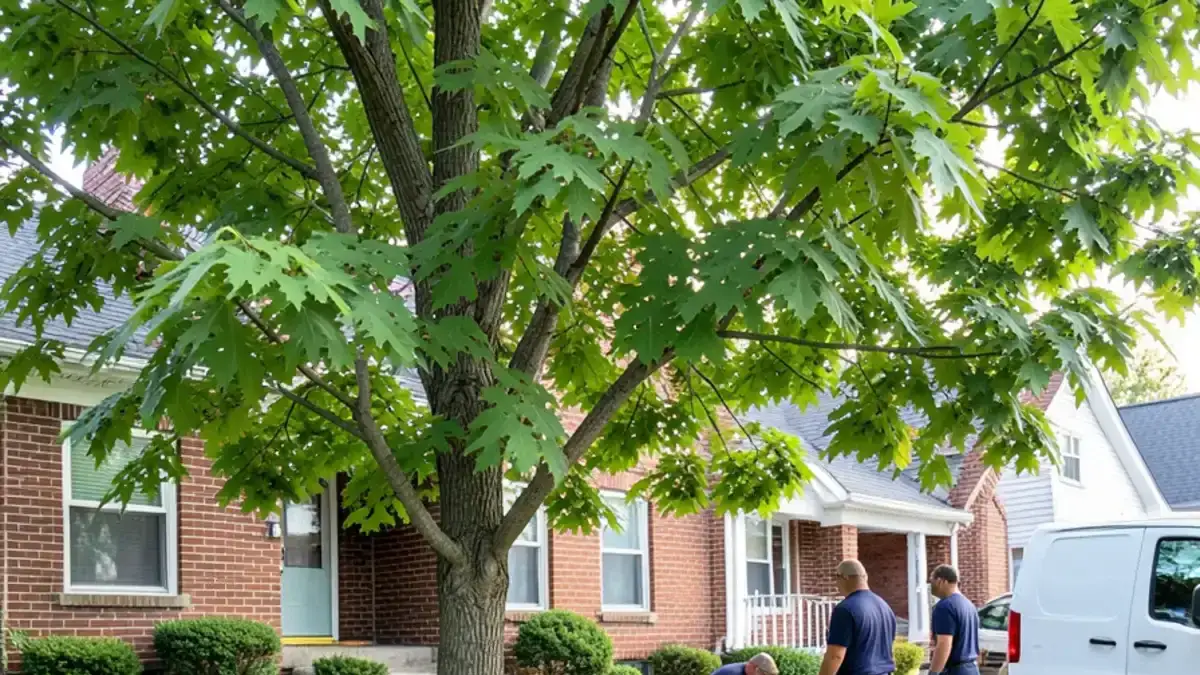
Tree roots in a sewer line show up as slow drains across the whole house, gurgling toilets and backups that return a few months after each cleaning. They get in through leaking joints in older clay and cast iron laterals. Cutting or jetting clears them for a while; only lining or replacing those joints keeps them out.
Signs roots have found your lateral
Roots build slowly, so the early signs are easy to blame on something else. Watch for these:
- Drains throughout the house slowing down at the same time, worst in the lowest fixtures.
- Gurgling from a toilet or floor drain when the washer drains or a tub empties.
- A basement floor drain that backs up during heavy water use, then slowly clears.
- Main line clogs that come back a few months after each cleaning, often worse in late spring and summer when trees are growing hardest.
- A cable that comes back wrapped in thin, hairy fibers.
- A strip of grass over the sewer route that stays greener than the rest of the lawn, or a soft spot that starts to sink.
One of these alone could be a simple clog. Two or three together point toward roots.
Think roots have found your sewer lateral?
- Your call goes to an independent local plumbing company that does the work.
Why older south Macomb County laterals let roots in
The pipe that carries wastewater from your house to the street, called the lateral, is a long buried tube full of warm, wet, nutrient-rich water. To a tree, a leaking joint in that pipe is the best water source in the yard. Pipe material decides how easily roots get in. Homes built through the 1950s and 1960s commonly have laterals of vitrified clay or cast iron. Clay pipe comes in short lengths, so a long lateral has many joints, and the mortar or early gaskets at those joints crack as the ground shifts. Cast iron is joined at hubs packed with oakum and lead, and those hubs loosen over decades. Every loose joint lets a little moisture escape into the soil, which is exactly what draws roots toward it.
The south and center of Macomb County were built up earlier than the northern townships, and that shows in the housing. In Mount Clemens, about six in ten homes were built before 1960, and the median home dates to 1955. Clinton Township has even run a pilot program aimed at failed vitrified clay sewer leads, open to income-qualified owners whose homes date to 1974 or before. By comparison, the median home in Macomb Township was built around 2000, when PVC laterals with glued joints were standard. Plastic pipe with solvent-welded joints gives roots far fewer ways in.
Trees that tend to find sewer lines
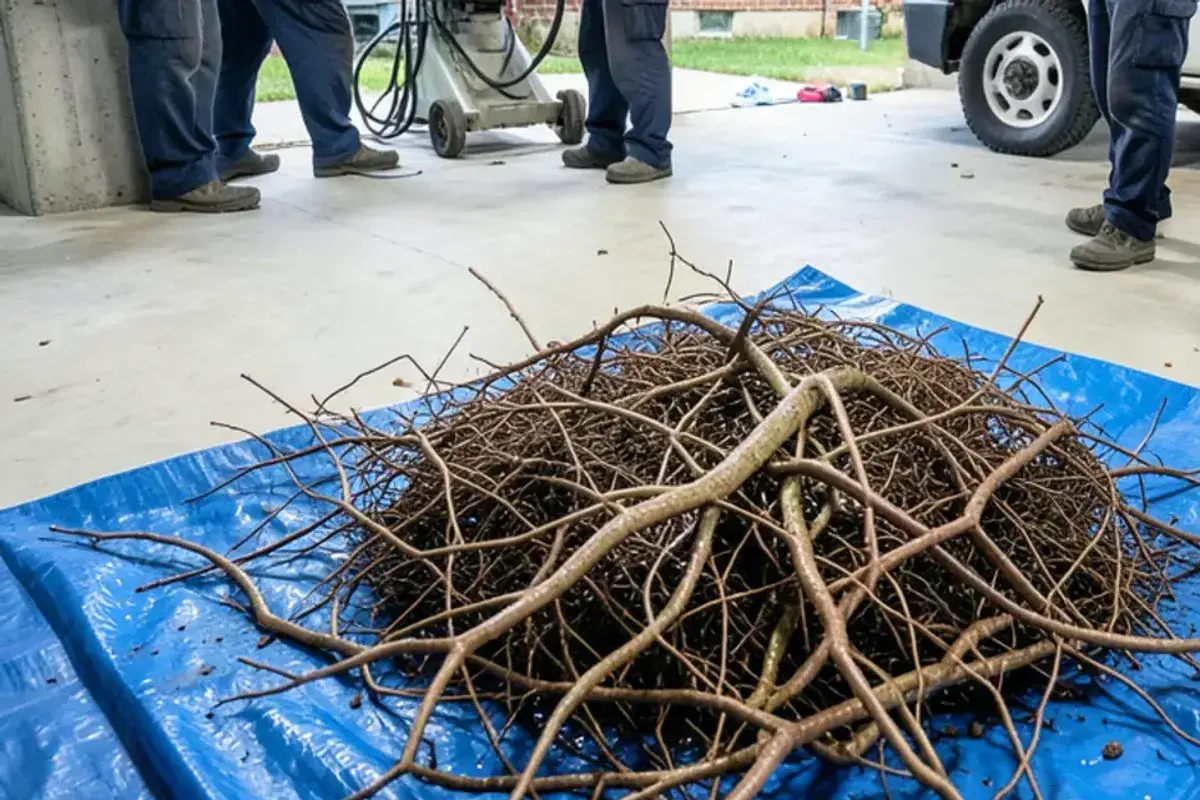
Any tree can send roots into a leaking pipe, and roots travel well past the edge of the canopy. Fast-growing, water-hungry trees cause the most trouble. Willows, poplars and cottonwoods, silver maples and elms all have a reputation among plumbers for finding laterals. Big shrubs planted close to the house can do it too, since the lateral is shallowest near the foundation in many yards.
If you're planting, find out where your lateral runs first. A camera with a locator can trace it and mark the route on the lawn.
Confirming roots with a camera
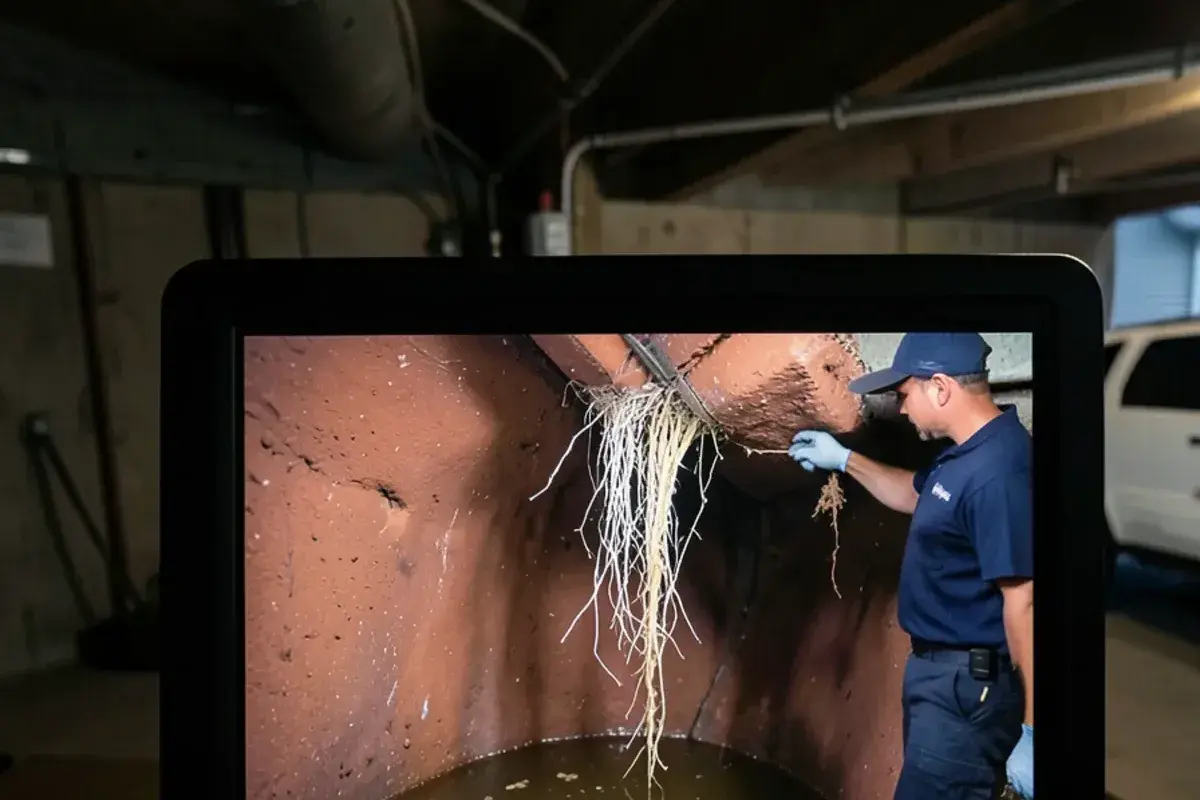
Guessing is expensive here, because the fixes range from a cleaning to a full replacement. A sewer camera inspection shows whether roots are present, how many joints they've entered, and whether the pipe around them is still round and in line. The footage counter gives the distance to each intrusion, and a locator above ground gives its depth.
What the camera finds also tells you whether the pipe can handle the next step. Fine roots at an otherwise sound joint are a cleaning problem. Roots growing through a cracked or shifted section mean the pipe itself has failed.
Cutting, jetting, lining or replacing
| Option | What it does | Best fit | Limits |
|---|---|---|---|
| Mechanical root cutting | A cable with a cutting blade shears roots inside the pipe | Quick relief for a blocked line | Leaves root stubs and the open joint; regrowth is likely |
| Hydro jetting with a root nozzle | High-pressure water and a spinning cutter clean the full pipe wall | Heavy root mats, plus grease or sludge mixed in | Needs a pipe sound enough to take the pressure |
| Section repair | Dig at one spot and replace the damaged joint or length | One or two bad joints in an otherwise good line | Doesn't help if roots are entering along the whole run |
| Cured-in-place lining | A resin liner cures into a jointless pipe inside the old one | Many root-prone joints in a pipe that still holds its shape | Pipe must be cleaned of roots first; won't fix a collapse or a sag |
| Full replacement | New PVC from the house to the connection | Cracked, crushed or badly offset pipe | The most digging, unless done by pipe bursting |
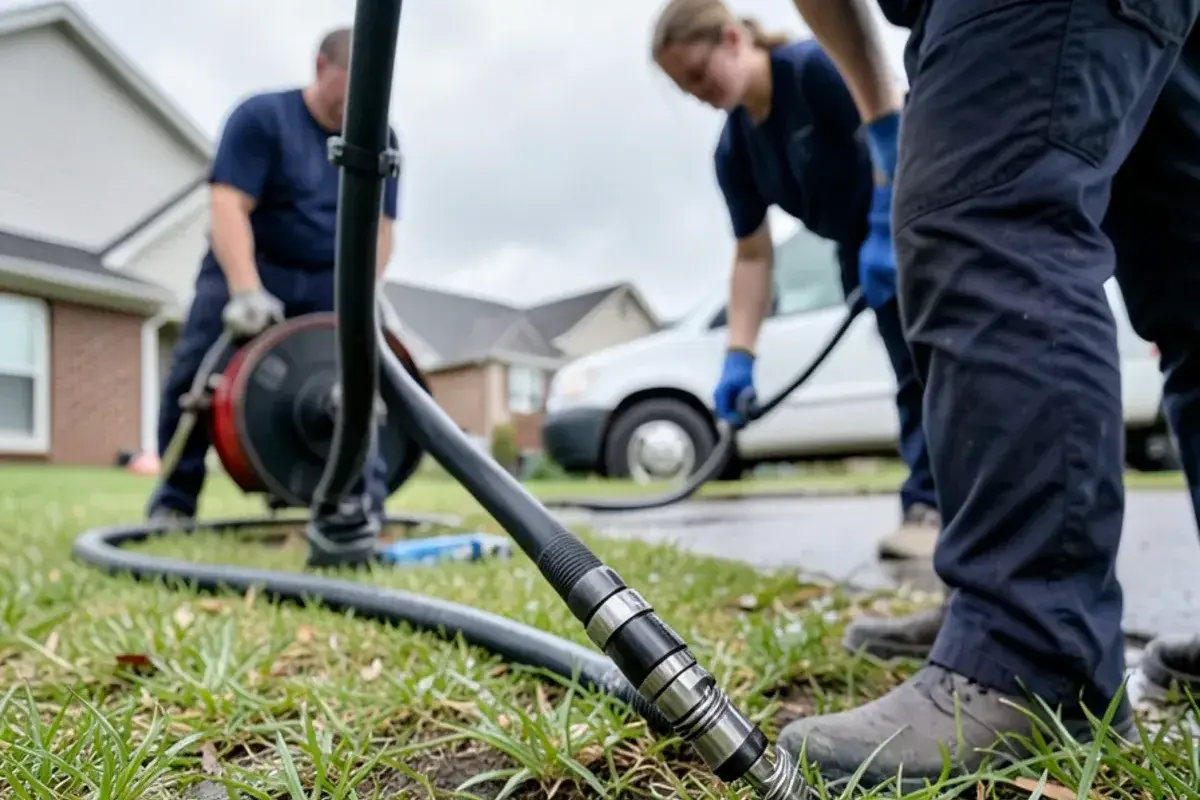
Hydro jetting clears roots more completely than a cable, which makes it the usual prep step before lining. Lining and replacement are the only options that take away the open joints, so they're the ones that end the cycle. When the camera shows one bad section, sewer line repair at that spot may be all you need.
What plumbers commonly find once the roots are out
The camera run after a cleaning often tells a different story than the backup did. Roots tend to cluster in a few predictable places: the first joint outside the foundation wall, joints under a parkway tree, and the connection to the public sewer, where the lateral meets a tap or wye in the main. A line with roots at two joints and clean pipe between them is a good candidate for spot repairs. A line with roots at every joint for sixty feet is telling you the whole run is leaking.
Several findings change the plan, and each fix has a blind spot:
- A belly or sag lets water and solids settle in the low spot, and roots follow the moisture. Lining follows the old pipe's shape, so it can't lift a belly. Only digging and relaying that section fixes the grade.
- At offset or cracked joints, a liner can bridge a modest offset, but a broken or crushed section needs excavation before or instead of lining.
- Roots rarely reach cast iron under the basement floor, but scale and rust inside old cast iron can snag paper and mimic a root clog. Lining the outdoor lateral won't help that part.
- When roots sit at the main connection, work at the tap may fall in the road right-of-way, which brings in the city or township and sometimes a separate permit.
Root killers deserve an honest word too. They can thin the growth between cleanings, but they don't seal anything. And a cleaning schedule isn't a failure. For a sound pipe with a few root-prone joints, a yearly jetting may cost less over time than lining, at least until the camera shows the pipe itself breaking down.
Permits and digging before a lateral repair
Clearing a stoppage doesn't need a permit under LARA's rule, but replacing or relining a section of sewer is regulated work, and your city or township building department issues that permit. Anyone digging, including a homeowner, has to contact MISS DIG 811 at least three business days ahead, and utilities don't mark your private sewer, which is why the camera and locator trace come first. Several local departments push the same order of operations. Mount Clemens advises a camera inspection of the sanitary sewer lead before excavation, and Roseville's water report tells residents to get a second opinion before having a sewer dug up.
Keeping roots out after the line is cleared
If you're staying with cleaning for now, keep a log of each visit. A line that needs root cutting every year has a predictable schedule, and booking it ahead of the summer growth spurt beats waiting for a backup.
For a lasting fix, the joint has to be sealed. A liner does it from inside without digging up the yard, and a replaced section with glued PVC joints does it from outside. Either way, plant new trees and large shrubs well away from the lateral's route, and think twice before planting a willow or silver maple anywhere near the line to the street.
Living with roots or ending them
Roots in a sewer line are a slow problem with a clear decision point. If the camera shows sound pipe with a few root-prone joints, a cleaning schedule is a reasonable plan. If it shows roots at most joints, cracks, offsets or a sag, cleaning only buys time, and lining or replacement ends the cycle. Either way, the camera footage is what makes the decision for you. To have a plumber camera and clear your lateral, call (207) 419-2600 and we'll connect you with one who covers your community.
Common questions
Will roots grow back after they're cut out of a sewer line?
Yes, usually. Cutting removes the roots inside the pipe but leaves the open joint they came through, and the tree keeps sending new growth toward it. Many homeowners settle into a cleaning schedule based on how fast the roots return, until they decide to line or replace the line.
Do I have to cut down the tree to fix the sewer?
No, not always. Lining or replacing the damaged section with jointless or solvent-welded pipe takes away the gap the roots use, and the tree can stay. A tree right on top of a line that needs replacement is a harder call, and it's worth having an arborist look at it before anyone digs near the trunk.
Is the city responsible for roots in my sewer lateral?
No, usually not. Across Macomb County, the lateral from your house to the public sewer is generally the owner's to maintain, roots included. Fraser, for example, puts any blockage between the home and the city main on the homeowner. Rules on where that responsibility ends vary, so check with your city or township water and sewer department.
Do chemical root killers work in a sewer lateral?
Yes, partly. Foaming root treatments can kill the growth inside the pipe and slow the next round, but the dead roots still have to be cut or jetted out, and the open joint stays open. Read the label for septic and lawn warnings. They suit a line on a cleaning schedule; they don't replace a camera look or a repair.
Where we can help
Think roots have found your sewer lateral?
- Your call goes to an independent local plumbing company that does the work.